
When families start searching for dementia care, two terms come up constantly: board and care homes and memory care facilities. The board and care vs. memory care question comes up early — and it matters more than most people realize. These options sound different enough that most families assume they’re completely separate types of care. The reality is more nuanced, and understanding that nuance is what makes the difference between a good placement and a difficult one.
This post walks through the real differences between board and care vs. memory care — staffing ratios, environment, cost, and level of care — and what the research says about which type of setting tends to produce better outcomes for people living with dementia, especially those with behavioral symptoms.
What Is a Memory Care Facility?
“Memory care facility” is not a license category in California. It’s a marketing term — one used by a wide range of providers, from large dedicated memory care wings inside assisted living campuses to small residential homes specializing in dementia.
What unites them is a stated focus on Alzheimer’s disease and other dementias. What varies enormously is size, staffing, physical environment, and how care is actually delivered day to day.
When most people picture a memory care facility, they picture a large, purpose-built unit — secure, structured, and staffed in shifts. That’s one model. It’s not the only one.
What Is a Board and Care Home?
A board and care home — formally called a Residential Care Facility for the Elderly (RCFE) in California — is a licensed residential setting where a small number of older adults live together and receive personal care services. California limits these homes to six residents.
Board and care homes are licensed by the California Department of Social Services under the same RCFE framework that governs larger assisted living facilities. They are not unlicensed group homes. They are not nursing homes. They sit within the assisted living continuum — so when families ask about a board and care home vs. assisted living, the honest answer is that board and care is assisted living, delivered at a residential scale rather than an institutional one.
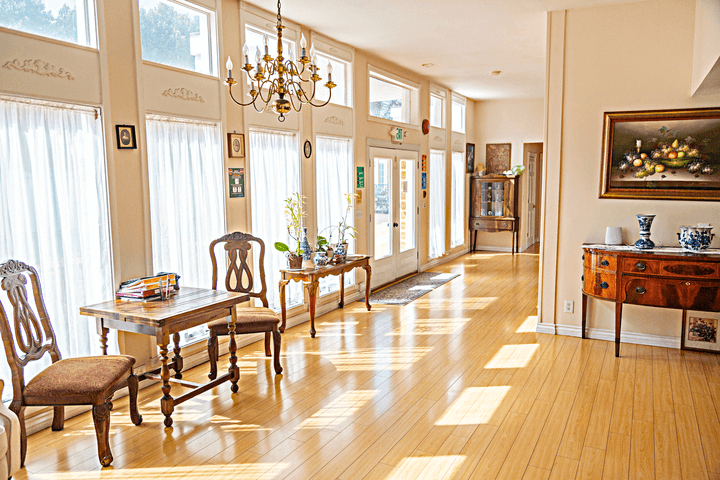
Many board and care homes specialize in memory care. When they do, they offer dementia-focused care inside a small, home-like environment with a consistent staff and a low resident-to-caregiver ratio. That combination turns out to matter quite a bit for people with dementia.
How Board and Care vs. Memory Care Actually Compares
Families weighing board and care vs. memory care aren’t making an apples-to-apples choice. They’re often choosing between two very different physical and social environments — one that operates at the scale of a residential home and one that operates at the scale of a healthcare institution. Here’s what that difference looks like across the factors that matter most.
Staff-to-Resident Ratios
In larger memory care facilities, day-shift ratios commonly run 1:8 to 1:12 — one caregiver responsible for eight to twelve residents at a time. In a small dementia care home limited to six residents, ratios of 1:3 or better are typical. That gap isn’t just a number. It determines whether a caregiver has time to notice a resident’s early signs of distress, sit with them through a difficult moment, or adjust an approach mid-task — or whether they’re moving too fast to do any of those things.
Caregiver Consistency
In larger facilities, shift rotations and staff turnover mean residents frequently encounter unfamiliar faces. In a small board and care home, the same caregivers are typically present day after day. For someone with dementia — whose ability to form new memories is impaired — familiarity with the people providing care directly affects their sense of safety and calm.
Environment and Stimulation
Dementia affects the brain’s ability to filter and process sensory input. Shared dining rooms, hallway activity, communal programs, and overhead announcements pass unnoticed by cognitively intact residents. The same inputs can overwhelm someone with moderate to advanced dementia. A small residential home operates at a quieter, more predictable register.
Routine and Individualization
In a small home, the daily schedule builds around the residents who live there. Mealtimes, activities, and caregiving tasks can be tailored to the group — and to individual patterns. In a larger facility, programming serves dozens of residents. Individuals adapt to the institution rather than the other way around.
Cost
In the San Fernando Valley, board and care homes with memory care specialization generally run $4,000 to $8,500 per month. Large memory care facilities in the greater Los Angeles area typically range from $6,000 to $9,000 or more. The cost difference reflects real structural differences — not a gap in quality. A board and care home at $6,500 per month that bundles meals, personal care, memory care services, and a 1:3 staff ratio often delivers better overall value than a larger facility charging less on paper but billing separately for care upgrades and requiring a transfer to a higher-cost unit as dementia progresses.
What the Research Says About Environment and Dementia Behavior
Behavioral symptoms — agitation, aggression, wandering, sundowning, resistance to care — are among the most common and most distressing features of moderate to advanced dementia. The National Institute on Aging recognizes that agitation and aggression in dementia almost always happen for a reason, and finding that cause is the first step toward managing it.
Research published in The Gerontologist has examined how residential care environments affect behavioral outcomes in dementia patients. Smaller settings with lower resident-to-staff ratios consistently show less agitation and more individualized behavioral management. The mechanism isn’t mysterious: when staff know a resident well, they recognize early signs of distress before those signs escalate. When the environment is quieter and more predictable, fewer triggers exist to begin with.
For families navigating care for someone with aggressive dementia, this is not a minor consideration. Research on environmental triggers consistently points to noise, crowding, unfamiliar caregivers, and loss of routine as primary contributors to escalation.
Memory Care for Aggressive Patients: What “Specialized” Actually Means
Many large memory care facilities advertise specialized programming for behavioral presentations. It’s worth asking what that specialization looks like in practice.
In a large facility, behavioral management typically means a defined protocol: monitoring, documentation, possible medication adjustment, and — if behavior becomes unmanageable — a conversation about whether the resident remains an appropriate fit. Dementia patients with aggressive or combative presentations face disproportionate risk of discharge from larger facilities when their behavior becomes difficult to manage within the group setting.
In a small residential care home with genuine dementia expertise, the approach looks different. Because the caregiver-to-resident ratio is low, staff have time and familiarity to respond to behavioral episodes individually — to de-escalate rather than manage, to adjust the environment rather than the medication, to treat the person rather than the behavior. Continuity of care means that a caregiver who knows how a resident responds to a certain kind of touch, tone of voice, or time of day has tools that no protocol can replicate.
This is why care homes for aggressive dementia patients often provide more stable, longer-term placement than larger facilities — not because they offer more clinical resources, but because the environment generates fewer triggers and the staff response is more individualized.
What to Look For When Evaluating Any Setting
If your loved one has behavioral symptoms — or if you anticipate they will as the disease progresses — these are the questions worth asking any care setting you evaluate. For a broader framework on when to start this search, see our guide to recognizing the signs it’s time for memory care.
What is your resident-to-caregiver ratio, and does that change at night? Lower ratios mean more time per resident, which matters most during behavioral episodes and personal care tasks that can trigger resistance.
How do you handle agitation or aggressive behavior? Listen for answers that describe individualized de-escalation approaches, environmental adjustments, and caregiver familiarity. Be cautious of answers that lead quickly to medication or discharge.
What happens if care needs increase? Some settings accommodate a resident through advancing stages of dementia; others have clinical thresholds that require transfer. Knowing this in advance prevents a painful and disorienting move later.
What does staff continuity look like? Turnover is a known challenge across elder care. In a small home, you can often meet the people who will be providing care directly — and assess their familiarity with dementia presentations firsthand.
Is the physical environment predictable and low-stimulation? Walk through at different times of day if possible. Notice the noise level, the foot traffic, the lighting.
How Royal Garden Board & Care Fits Into This Picture
Royal Garden Board & Care operates three licensed residential care homes in the San Fernando Valley — two in Tarzana and one in Valley Glen — each serving a maximum of six residents. All three homes specialize in memory care, including residents with behavioral and aggressive presentations.
Because each home is small, care is genuinely individualized. Residents are known by name, by history, by habit, and by the specific patterns that precede distress. The continuum care model means that as a resident’s dementia progresses and care needs increase, they remain in the same home, with the same caregivers — avoiding the disorienting relocations that larger facilities often require as a resident moves from one level of care to the next.
Royal Garden I in Valley Glen offers 6 private bedrooms, a floor-to-ceiling fireplace, a beautiful garden-like backyard, and sits adjacent to a community park. Royal Garden II in Tarzana features 3 private bedrooms, a shared bedroom, a resort-style pool and tennis court, and a unique guest house for up to two residents. Royal Garden III — also in Tarzana — includes 6 private bedrooms with private bathrooms, an entertainment center with a grand piano, a colorful patio with a private picnic area, and charming park-like grounds.
If you’re trying to figure out which setting is right for your loved one — and whether board and care vs. memory care makes more sense given where they are now — we’re glad to talk it through. Reach out here.
The Bottom Line
The board and care vs. memory care question isn’t really about which label a provider carries. It’s about what the environment actually looks like, how caregivers actually work, and whether the setting can meet your loved one where they are — including on the hard days.
For many people with dementia, especially those with behavioral symptoms, a small residential home produces better outcomes than a larger institutional setting. Not because small homes offer more clinical resources — but because they offer fewer triggers, more familiar faces, and more room for the kind of individual attention that behavioral presentations require.
That’s the case worth understanding before you make a decision.